Designing the Scalloped Gift Box with Ribbon Closure: Structural Mechanics and Material Selection
The intersection of structural engineering and aesthetic presentation is most visible in packaging designs that serve a dual purpose: protecting contents while communicating value. The Scalloped Gift Box with Ribbon Closure represents a specific niche within folding carton design where decorative elements perform functional roles. Unlike standard tuck-end boxes or rigid setup boxes, this format utilizes an interlocking flap system enhanced by decorative curvature to secure the package. Understanding the technical specifications, material constraints, and assembly logic of this box style is essential for packaging designers, small business owners, and craft professionals aiming to elevate their product presentation without resorting to adhesives or complex machinery.
Structural Integrity Through Double-Wall Construction
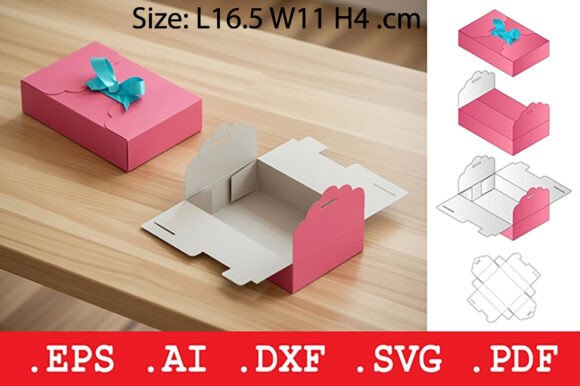
A primary concern with non-rigid folding cartons is the perceived lack of durability compared to glued alternatives. The Scalloped Gift Box with Ribbon Closure addresses this vulnerability through specific geometric reinforcement. The template features double-layered side walls, a critical design element that distinguishes it from simpler sleeve-style boxes. When assembled, the inner and outer wall panels fold against one another, effectively doubling the thickness of the vertical faces. This lamination effect creates a column strength that resists crushing forces during handling and transport.
This double-wall architecture also serves as the anchor point for the scalloped top flaps. Because the side walls provide a stable vertical plane, the interlocking scallops on the lid can engage precisely without the box bowing outward. For users working with lighter weight papers at the 180 gsm end of the recommended spectrum, this structural redundancy is mandatory. It compensates for the lower stiffness of the substrate, ensuring the box maintains a clean rectangular profile rather than collapsing into a parallelogram shape under the tension of the ribbon closure.
The Mechanics of Interlocking Scalloped Flaps
The defining visual characteristic of this packaging solution is the scalloped edge, but its function extends beyond ornamentation. In packaging terminology, these curves act as friction locks. Straight-edged tuck flaps often rely solely on the friction of the paper against the inner wall, which can loosen over time or if the paper grain runs parallel to the fold. The convex and concave geometry of the scallops increases the surface area of contact between the overlapping flaps.
When the top flaps are folded inward and interlocked, the curved edges nest into one another. This nesting creates a mechanical interference fit that resists accidental opening. The precision of this lock depends entirely on accurate cutting, which is why the availability of .DXF and .SVG files is significant for digital fabrication. A laser cutter or CNC router following these vector paths ensures that the tolerance between mating scallops remains consistent, typically within 0.1mm to 0.2mm depending on material thickness. Hand-cutting this geometry rarely achieves the friction necessary for a secure closure, making digital file formats a prerequisite for professional results.
Material Science: Optimizing for 180-350 GSM Substrates
The specified paper weight range of 180 to 350 gsm (grams per square meter) dictates the performance envelope of the Scalloped Gift Box with Ribbon Closure. Selecting a substrate outside this window compromises either the assembly process or the final structural integrity. Understanding the behavior of paper fibers within this range allows creators to match materials to specific use cases.
- 180-220 gsm: Ideal for lightweight items such as jewelry, silk scarves, or stationery. At this weight, the paper scores easily and folds crisply without cracking. However, the double-wall construction becomes vital here, as single-ply walls at this weight would be too flexible to support the ribbon tension.
- 230-280 gsm: The optimal sweet spot for general retail packaging. This weight offers sufficient rigidity for the scalloped flaps to maintain their shape while remaining pliable enough for manual assembly without specialized scoring tools. Textured cardstocks and linen-finish papers typically perform best in this range.
- 290-350 gsm: Reserved for premium presentations requiring high load-bearing capacity. While durable, papers at this upper limit require careful attention to grain direction. Folding against the grain at 350 gsm can cause fiber fracture along the score line, resulting in unsightly white cracks on colored stock. Deep scoring or creasing matrices are often necessary when fabricating at this thickness.
Grain direction is a frequently overlooked variable in folding carton design. For the Scalloped Gift Box with Ribbon Closure, the grain should ideally run perpendicular to the main fold lines of the box base. This orientation maximizes the bending stiffness of the side walls and prevents the box from warping due to humidity changes. When utilizing the provided .AI or .EPS source files for customization, designers should verify grain alignment before sending files to print or cut, as rotating the layout by 90 degrees can fundamentally alter the box's performance.
Ribbon Integration and Slot Geometry
The integrated ribbon slots are not merely holes punched through the paper; they are engineered stress points. The slot dimensions in the vector templates are calibrated to accommodate standard satin or grosgrain ribbons ranging from 6mm to 12mm in width. The placement of these slots relative to the scalloped edge is calculated to distribute the pulling force across the double-wall section rather than concentrating it on the single-ply flap.
When threading the ribbon, the path matters. The design intends for the ribbon to pass through the slot, cross over the interlocked scallops, and return through the opposing slot. This creates a compressive force that pushes the scalloped flaps downward, tightening the interlock. If the ribbon is tied too loosely, the mechanical advantage of the slot system is lost. Conversely, overtightening with a narrow ribbon on 180 gsm paper can slice through the material. Users experimenting with wider ribbons or heavier substrates may need to adjust the slot width in the Adobe Illustrator source file to prevent binding or tearing.
Digital Fabrication Workflows and File Utilization
The versatility of the Scalloped Gift Box with Ribbon Closure lies in its compatibility with various production methods. The included file suite supports workflows ranging from industrial die-cutting to hobbyist crafting. Each format serves a distinct role in the manufacturing chain.
The .DXF (Drawing Exchange Format) file is the industry standard for CNC and laser cutting hardware. It contains pure geometric data without styling attributes, ensuring that the machine interprets cut lines and score lines correctly. When importing DXF files into laser software, operators must assign different power settings to cut versus score layers. The scalloped edges require continuous vector cutting, while fold lines benefit from low-power perforation or kiss-cutting to facilitate clean bends without severing the material.
For users employing vinyl plotters or digital craft cutters like Cricut or Silhouette, the .SVG (Scalable Vector Graphics) format provides immediate usability. SVGs retain layer information and scaling properties that prevent distortion when resizing the box for different products. Because the Scalloped Gift Box with Ribbon Closure relies on precise proportions, scaling should always be done uniformly. Stretching the box in only one axis will misalign the scallop intersections and render the closure mechanism ineffective.
Print professionals will utilize the .EPS and .PDF formats for offset or digital printing. These files include bleed areas and registration marks necessary for aligning printed graphics with the structural cut lines. The .AI (Adobe Illustrator) source file remains the master document for any modifications. Whether adjusting the box dimensions to fit a specific product or adding custom branding to the scalloped flaps, working in the native AI environment preserves the parametric relationships of the design. This is particularly important when modifying the ribbon slot size, as the surrounding reinforcement geometry must be updated simultaneously to maintain structural balance.
Assembly Logic and Flat-Pack Efficiency
The economic viability of folding cartons often hinges on storage and shipping efficiency. The Scalloped Gift Box with Ribbon Closure ships and stores flat, occupying a fraction of the volume of pre-assembled rigid boxes. This flat-pack capability reduces warehousing costs and carbon footprint for businesses scaling their operations. However, the trade-off is manual assembly time.
Efficient assembly follows a specific sequence to leverage the double-wall construction. Operators should first establish the base rectangle and lock the side tabs before engaging the top scallops. Pre-folding all score lines prior to applying glue (if used for the base) or inserting the ribbon significantly speeds up the process. For high-volume production, creating a simple jig or folding form can reduce assembly time by standardizing the pressure applied to the double walls. The non-rigid nature of the structure means that muscle memory plays a significant role in achieving consistent results; the first few boxes assembled by a new operator may vary slightly until the tactile feedback of the interlocking scallops is mastered.
Ultimately, this packaging format offers a sophisticated alternative to generic gift wrapping. By combining the tactile satisfaction of a ribbon closure with the engineered precision of interlocking scallops and reinforced walls, it bridges the gap between disposable packaging and keepsake presentation. Success depends less on artistic flair and more on respecting the material limitations and structural logic embedded in the template files. Whether produced via laser cutter for a boutique brand or hand-assembled for a special occasion, the integrity of the final object rests on the faithful execution of these design principles.