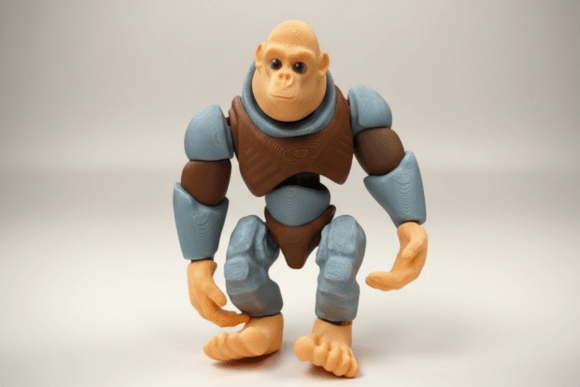
Articulated Print in Place Gorilla: A Functional Desk Companion Beyond Decoration
The Articulated Print in Place Gorilla represents a specific niche in functional 3D printing where mechanical engineering meets tactile satisfaction. Unlike static statues or models requiring hours of post-processing, this figure is designed to be removed from the build plate and used immediately. Its primary value lies not just in its aesthetic appeal, but in its utility as a robust, interactive object that serves distinct purposes for adults in professional and creative environments. The "print-in-place" designation means all joints, tolerances, and articulation points are generated during a single print cycle without support structures, resulting in a cohesive unit that maintains structural integrity even under active handling.
Tactile Feedback and Cognitive Focus in Professional Settings
For professionals aged 20 to 50, the modern workspace often involves prolonged periods of screen time and cognitive load. The Articulated Print in Place Gorilla functions effectively as a high-durability fidget tool. While traditional fidget spinners or stress balls can feel juvenile or lack resistance, this model offers complex mechanical feedback. The smooth, integrated joints provide varying levels of friction and range of motion, allowing users to engage their hands in non-distracting movement while thinking through complex problems or participating in virtual meetings.
The multi-tonal color scheme—featuring tan extremities, a dark brown torso, and slate-blue limb plating—is not merely decorative; it provides visual segmentation that helps the eye track movement during manipulation. This visual-tactile connection can aid in grounding techniques for individuals managing workplace stress or ADHD. Because the model is engineered for durability, it withstands the repetitive torque and pressure associated with nervous energy, unlike more delicate artistic prints that might snap at the joint connections.
Evaluating Print Parameters for Functional Durability
Achieving the intended robustness of the Articulated Print in Place Gorilla requires adhering to specific technical considerations. Users prioritizing function over speed should note that the recommended 10–15% infill is calibrated specifically for this geometry. Increasing infill significantly beyond this range does not necessarily improve joint performance and may actually increase weight and friction, making articulation stiffer. Conversely, dropping below 10% risks shell deformation under grip pressure.
Wall count is arguably more critical than infill for this application. Sticking to 2–3 wall lines ensures the outer shell has enough thickness to absorb stress without transferring it to the internal joint mechanisms. When selecting layer heights, the choice between 0.2 mm and 0.12 mm dictates the user experience. A 6-hour print at 0.2 mm produces a slightly textured surface that offers better grip and hides layer lines, making it ideal for a daily driver desk toy. The 8-hour 0.12 mm option yields a smoother finish better suited for display or collectible purposes, though the tighter tolerances may require precise printer calibration to prevent joint fusion.
Scaling Considerations and Joint Integrity
One of the most practical aspects of this model is its scaling flexibility, though this comes with mechanical caveats. While digital files allow for infinite resizing, the physical laws governing 3D printed plastics impose limits. The Articulated Print in Place Gorilla can technically be scaled down to 70%, but doing so reduces the cross-sectional area of the joint pins and sockets. At this smaller size, the figure transitions from a robust handling toy to a fragile shelf piece. The plastic becomes less forgiving of lateral forces, and the risk of joint seizure due to minor printing imperfections increases exponentially.
For users intending to use the gorilla as an active fidget or stress relief tool, maintaining a minimum scale of 85% is strongly advised. At this threshold, the joint clearance remains sufficient to accommodate standard FDM printing tolerances while retaining enough material mass to resist breaking. Scaling up beyond 100% generally improves durability and ease of movement, making larger versions excellent for users with larger hands or those who prefer a heavier, more substantial desk presence. However, larger scales will proportionally increase print time and material consumption, so balancing size with resource availability is a necessary planning step.
Versatility Across Different User Scenarios
The utility of the Articulated Print in Place Gorilla extends across various demographics and use cases within the maker and professional community:
- Office Professionals: Serves as a conversation starter and a discrete anxiety management tool during calls. The professional color palette avoids the bright, toy-like appearance of many articulated animals, making it appropriate for corporate desks.
- 3D Printing Enthusiasts: Acts as a benchmark print for testing retraction settings, cooling efficiency, and dimensional accuracy. Successfully printing this model with free-moving joints validates printer calibration without wasting filament on test cubes.
- Educators and Therapists: Useful in occupational therapy or special education settings where tactile stimulation aids focus. The predictable mechanical movement provides sensory input without electronic distraction.
- Collectors: High-resolution prints showcase the capabilities of modern slicers and printers. The seamless integration of colors (if using multi-material systems or careful filament swaps) and complex geometry makes it a display-worthy example of additive manufacturing design.
Material Selection and Post-Processing Realities
While the design is marketed as "straight off the build plate," real-world results depend heavily on material choice. PLA is the standard recommendation due to its low shrinkage and high stiffness, which keeps joints separate. However, for users seeking a premium tactile feel, PLA+ or Tough PLA variants offer slightly more flexibility, reducing the chance of catastrophic failure if the figure is dropped. PETG is generally discouraged for print-in-place articulated models unless the printer is perfectly dialed in; its tendency toward stringing and higher shrinkage rate frequently leads to fused joints or loose, wobbly connections.
Even with perfect prints, some users may find the joints initially stiff. This is normal and typically resolves after a brief break-in period of gentle manipulation. If stiffness persists, applying a minute amount of dry lubricant or silicone grease to the joint interfaces can restore smooth motion without damaging the plastic. Avoid petroleum-based lubricants, as they can degrade PLA over time. Understanding these material behaviors ensures the Articulated Print in Place Gorilla remains a functional asset rather than becoming shelf clutter due to unmet expectations regarding out-of-the-box performance.
Balancing Aesthetics with Mechanical Function
The multi-tonal aesthetic of the gorilla serves a dual purpose. Visually, the contrast between the slate-blue limb plating and dark brown torso creates a striking, almost industrial look that appeals to adult sensibilities. Mechanically, the color changes often correspond to different print zones or material transitions, which can help identify potential weak points or alignment issues during the printing process. For single-nozzle printers, achieving this look requires strategic pause-and-swap techniques or accepting a single-color finish. Multi-color users should ensure purge volumes are adequate to prevent color bleed at the joint interfaces, as trapped foreign material inside a socket is a common cause of articulation failure.
Ultimately, the Articulated Print in Place Gorilla succeeds because it respects the user's time and intent. It eliminates the barrier of assembly and support removal, delivering immediate gratification and utility. Whether serving as a sophisticated desk accessory, a diagnostic tool for printer tuning, or a durable companion for stress management, its design prioritizes real-world interaction over theoretical perfection. By understanding the relationship between scale, material, and intended use, adults can leverage this model to enhance their workspace environment with a tangible, functional piece of engineering.