Evaluating the Donut Photo Frame Fridge Magnet STL for 3D Printing
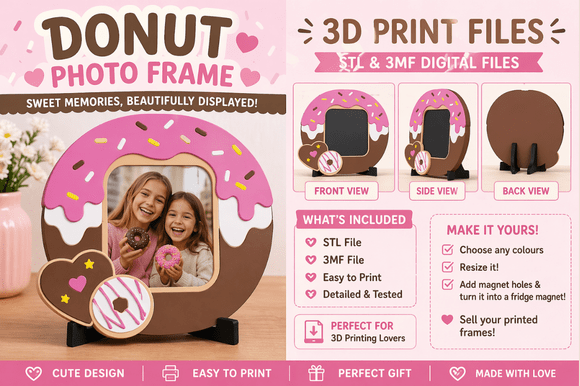
The intersection of functional home organization and personalized decor has created a significant demand for printable household items. Among these, the Donut Photo Frame Fridge Magnet STL represents a specific niche within the kawaii aesthetic category. This digital asset allows makers to fabricate a magnetic photo display that mimics the appearance of a frosted donut with sprinkles. For individuals researching this file, understanding its technical specifications, customization potential, and practical limitations is essential before adding it to a digital library. This evaluation focuses on the objective qualities of the file to help users determine if it aligns with their current printing capabilities and decorative goals.
Technical Composition and File Formats
When evaluating any 3D print file, the included formats dictate compatibility and workflow efficiency. The Donut Photo Frame Fridge Magnet STL package typically includes both standard STL files and 3MF (3D Manufacturing Format) files. Understanding the distinction between these two is critical for a successful print.
- STL Files: These are geometry-only meshes. They contain no color or assembly data. If you download only the STL version, you will likely receive separate parts (frame, frosting, sprinkles) that must be manually assembled and colored in your slicer software.
- 3MF Files: This format is increasingly preferred for multi-color projects. It embeds color information, assembly positioning, and sometimes even print settings directly into the file. For a design relying on specific color separation like a donut frame, the 3MF file significantly reduces preparation time and minimizes alignment errors.
Users should verify their slicer supports 3MF natively. While most modern software like Bambu Studio, Orca Slicer, and PrusaSlicer handle this format well, older versions of Cura may require plugins or manual re-assembly. The availability of both formats in this digital download ensures broader accessibility, but the 3MF variant offers superior utility for this specific application.
Multi-Color Printing Considerations
The primary appeal of the Donut Photo Frame Fridge Magnet STL lies in its layered visual details. Achieving the intended aesthetic requires careful consideration of your printer’s color changing capabilities. This design is optimized for multi-material systems (such as AMS or MMU) or manual color swaps.
For users with automated material changers, the file likely includes purge towers or wipe instructions embedded in the 3MF. However, makers using single-extruder printers must evaluate the feasibility of manual pauses. Because the "sprinkles" and "frosting" layers are often thin, frequent color changes can increase print time disproportionately to the visual gain. Users should inspect the layer height preview in their slicer before committing to a print. If the color transitions occur every few layers, the project may be better suited for an automated system or a simplified two-color variation rather than a full multi-color render.
Customization and Scalability Tradeoffs
A significant advantage of digital fabrication over store-bought frames is the ability to modify dimensions. The Donut Photo Frame Fridge Magnet STL is designed to be resizable, allowing users to accommodate different photo sizes or fit specific fridge real estate. However, scaling introduces mechanical tradeoffs that must be calculated.
The product description notes that magnet holes will grow or shrink proportionally with the model. This is a critical engineering constraint. Standard disc magnets come in fixed sizes (e.g., 6x2mm, 10x3mm). If you scale the frame up by 150% to hold a larger photo, the magnet recesses will also expand by 150%, potentially rendering standard magnets too loose to provide adequate holding force. Conversely, scaling down may make the recesses too small for available hardware.
To mitigate this, users should measure their available magnets before slicing. If scaling is necessary, consider modifying the magnet holes in CAD software to match your specific hardware, or plan to use adhesive to secure ill-fitting magnets. Additionally, surface painting or using the "split to objects" function in slicers allows for color customization without altering geometry, providing a safer route for personalization that avoids mechanical fitment issues.
Functional Utility and Display Suitability
Beyond aesthetics, the functional performance of a fridge magnet depends on weight distribution and magnetic strength. The donut shape creates a unique center-of-gravity challenge compared to rectangular frames. When evaluating this STL, consider the following functional aspects:
- Magnet Placement: Effective designs distribute magnets evenly around the perimeter. A donut frame requires sufficient magnetic surface area to prevent rotation when the fridge door opens or closes.
- Photo Retention: Evaluate how the photo is secured. Friction-fit slots are common but can warp over time due to PLA creep. Designs incorporating a removable backplate or clip mechanism generally offer better long-term durability.
- Material Selection: While PLA is standard for decorative items, PETG or ASA may be preferable for kitchen environments due to higher heat resistance and lower moisture absorption. However, these materials can be more difficult to print with fine details like sprinkles.
This frame is best suited for lightweight photos or cardstock. Heavy glossy prints or laminated documents may exceed the holding capacity of standard embedded magnets, especially given the circular leverage point of the donut shape.
Determining Fit: When to Choose This Design
Selecting the right 3D print file involves matching the design characteristics to user intent. The Donut Photo Frame Fridge Magnet STL is a strong candidate for specific scenarios while being less appropriate for others.
Ideal Use Cases
- Kawaii and Playful Decor: Users seeking to soften industrial kitchen aesthetics with rounded, colorful accents will find this design highly effective.
- Gift Making: As a DIY gift idea, the customizability allows for personalization (color matching recipient preferences) that mass-produced items cannot offer.
- Multi-Color Printer Testing: The distinct color regions make this an excellent benchmark file for testing registration accuracy and purge volumes on new AMS/MMU setups.
- Beginner Projects: Despite multi-color complexity, the geometry is generally forgiving, lacking extreme overhangs or intricate supports that plague more advanced models.
Situations Requiring Alternatives
- Minimalist or Professional Environments: The stylized nature may clash with modern farmhouse or industrial decor themes. Geometric or frameless designs may be more appropriate.
- Heavy-Duty Display Needs: For displaying thick cardstock, polaroids, or multiple photos, a dedicated clip-style or hinged frame STL would offer superior functionality.
- Single-Color Printing Limitations: Without post-processing (painting), a single-color donut frame loses much of its visual definition. Users restricted to monochrome printing should seek embossed or textured designs that rely on shadow rather than color for detail.
Final Evaluation Insights
The Donut Photo Frame Fridge Magnet STL serves as a versatile digital asset for makers interested in personalized, playful home decor. Its value proposition extends beyond the initial download through customization options and multi-format support. Success with this file depends largely on proper preparation: verifying magnet sizing relative to scale, ensuring slicer compatibility with 3MF data, and selecting appropriate materials for kitchen use.
By approaching this project with an understanding of both its creative possibilities and mechanical constraints, users can transform a digital file into a functional, sentimental object. Whether used as a test print for new equipment or a heartfelt custom gift, this STL offers a balanced combination of accessibility and customization that justifies its place in a curated 3D print library. Always remember that as a digital download, the quality of the final physical object relies entirely on printer calibration, material choice, and user modification.